Case Study
Robotic solutions for Oil & Gas
Strategic insight to navigate the robotics landscape and identify the best partners for oil & gas automation challenges

.png)


Strategic insight to navigate the robotics landscape and identify the best partners for oil & gas automation challenges
CamIn works with early adopters to identify new opportunities enabled by emerging technology.
of CamIn’s project team comprised of leading industry and technology experts


For $130,000, we highlighted opportunities for $10 million annual savings.
3 external expert teams specialised in emerging robotic solutions for oil & gas.
CamIn completed the work in 10 weeks, 3 times faster
The client faced a growing need to improve safety, operational efficiency, and asset uptime while reducing costs in a capital-intensive and regulated environment. It had not systematically evaluated emerging robotic solutions across different operational domains.
The engagement aims to deliver a prioritized portfolio of automation opportunities and vendor partnerships, on the way to facilitating pilot projects that demonstrate tangible value and scalability. The anticipated impact includes de-risking a planned multi-million-dollar digital transformation investment, enabling faster and safer deployment of robotic systems, and strengthening strategic alignment between innovation, operations, and safety divisions.
|
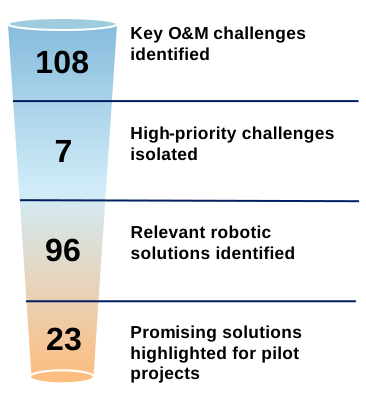
108 |
CamIn identified over 100 challenges addressable by robotics solutions across 4 key application areas. |
|
7 |
By considering the potential impact of robotics on efficiency, production and safety gains, CamIn distilled the 7 highest-priority challenges for the client. |
|
96 |
CamIn performed a detailed survey of the solutions landscape for the key challenges, identifying robotic products aimed at addressing them. |
|
23 |
By assessing each solution against the client’s detailed needs, CamIn highlighted the most promising products for pilot projects. |

CamIn provided a prioritised list of products to address the most pressing challenges for the client.
The client is now confirming an investment budget for pilot projects, and CamIn will support in developing detailed implementation plans for these pilots.
The client gained deep insights into the robotics landscape, and is now able to position itself as a leader in the space.
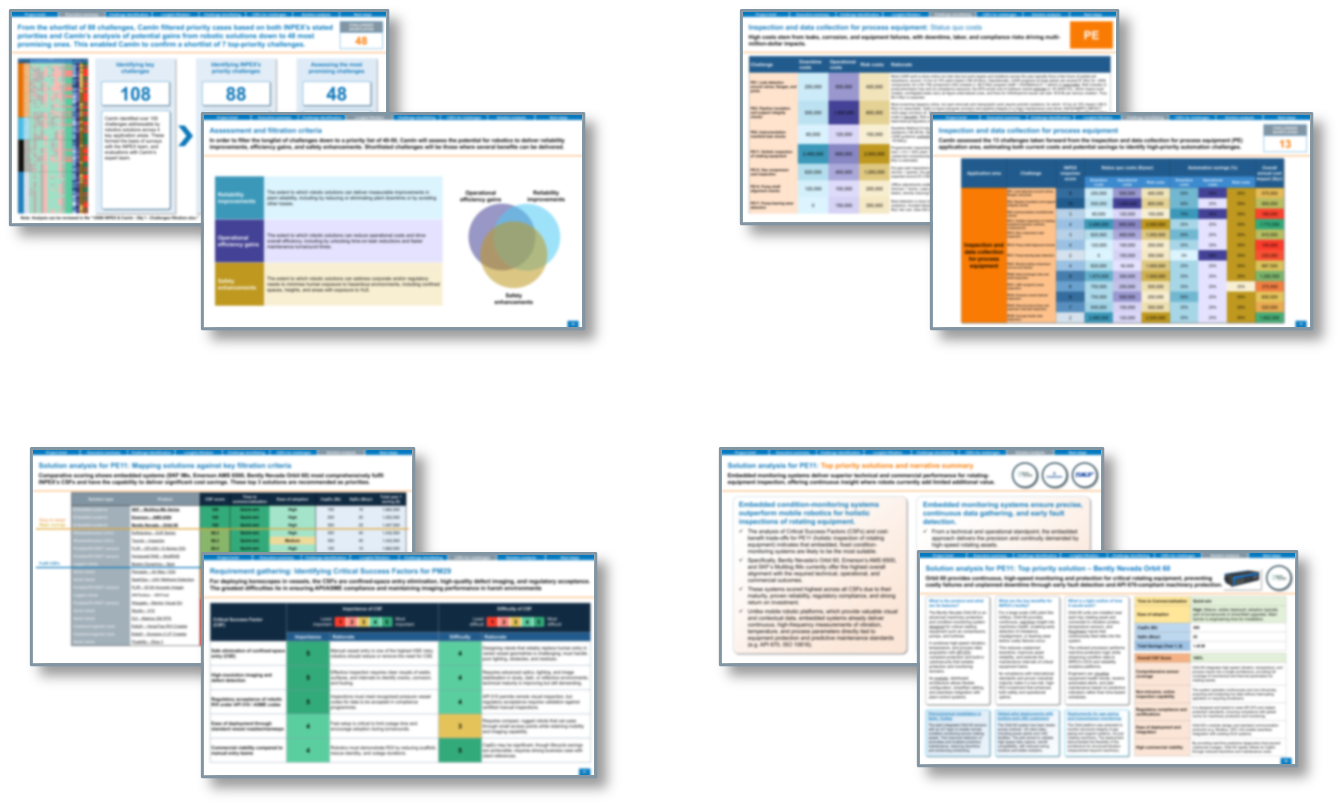
Download our detailed case study to learn more about how CamIn and our hand-selected expert project team delivered these results for our client.

.svg)


